The Social Opportunities of Delivering Construction in Occupied Buildings
25 May 2026
Across Europe, housing estates are being renovated to improve energy performance, reduce carbon emissions and provide more sustainable homes. Buildings account for around 40% of global greenhouse gas emissions, with 10% from embodied carbon from materials and construction processes, making renovation a central part of the transition to net zero (World Green Building Council, n.d.). Many of these projects, however, take place while residents continue living in their homes. Walls are opened, water and electricity are temporarily interrupted, neighbours move in and out, and daily routines continue alongside the construction works.
Delivering construction in occupied buildings is therefore as much a social challenge as it is a technical one. One of the central questions in this process is how to renovate buildings while protecting the social value of the people who call them home.
Supporting Residents Through Holistic Housing Renovation
One concept that has gained increasing attention is holistic housing renovation (Koops-Van Hoffen et al., 2023). The idea is simple: successful renovation is as much about improving the physical condition of a building as about supporting the people living through the process. The figure below visually summarises the negative and positive effects that renovation works may have on physical and mental health.
Figure 1: Holistic housing renovation impacts on health
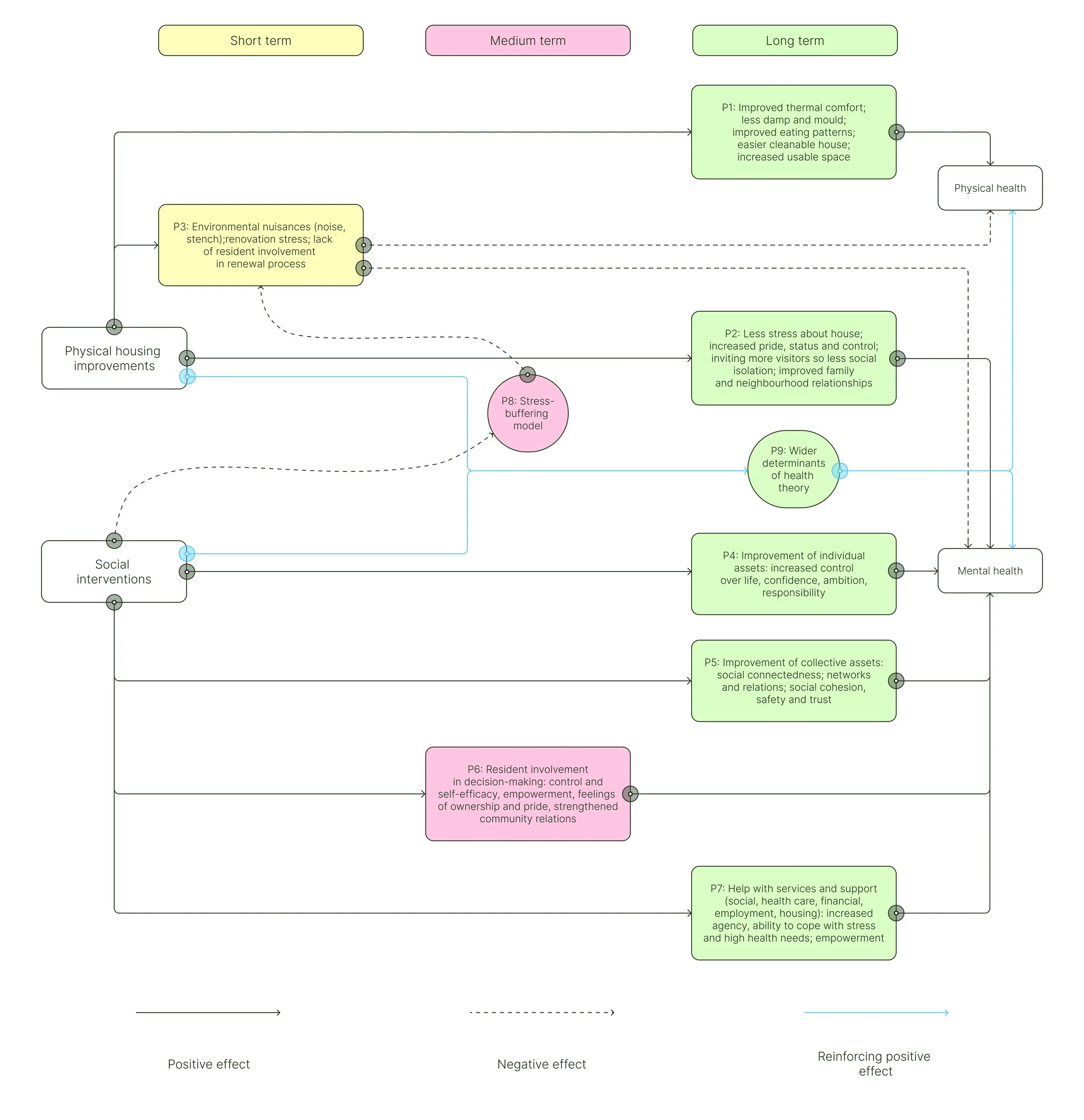
Adapted from Koops-Van Hoffen et al. (2023)
Koops-Van Hoffen et al. (2023) show that physical works and social interventions reinforce one another. Their framework suggests that when projects combine building improvements with measures that support residents throughout the renovation, they reduce stress and anxiety while strengthening both physical and mental well-being. Drawing on the wider determinants of health, they argue that improvements are greatest when multiple aspects of people's lives are considered together. Changes in one area, such as housing quality, can reinforce positive outcomes in others, including health, wellbeing and quality of life.
Holistic housing renovations that combine physical housing improvements with social and socioeconomic interventions, if executed well, are the key to delivery construction while accounting for residents’ mental and physical health (Koops-Van Hoffen et al., 2023).
This broader perspective shifts the way we think about construction. A renovation project becomes an opportunity to improve the lived experience of the people who remain in the building throughout the works.
Building Trust Through Communication and Leadership
Construction inevitably brings disruption. Noise, dust, temporary relocations and changing routines are all part of the process. According to Morgan et al. (2024), residents cope much better with construction when they retain a sense of control, receive predictable communication and perceive management as visible, fair and approachable. As uncertainty affects all parties, acknowledging it openly helps to create an environment in which people feel that leadership understands both the practical and emotional implications of living and working within a construction setting.
Akumen Lab's social impact assessment at Dolphin Square, a 1,200-home residential estate in Pimlico, London, reflected these findings. One of the project's greatest strengths was its relationship-based management approach. Leadership remained visible throughout the restoration, project teams built direct relationships with residents, and communication became part of everyday site management rather than an occasional update. Trust developed through small but consistent actions: answering questions, following up on concerns, explaining decisions and being present on site.
Strengthening the Sense of Community
Buildings are places where routines develop, neighbours become familiar faces and communities take shape. Lach et al. (2022) describe community wellbeing as something that emerges through everyday interactions in shared spaces. Construction should therefore protect these relationships while the physical environment is changing. The challenge is to ensure that an estate continues to feel like a neighbourhood rather than becoming a temporary building site.
Collective participation plays an important role in achieving this. According to Ricketts (2008), four aspects of community wellbeing are particularly enhanced through participatory processes:
1. Increased empowerment;
2. Enhanced vision-making and advocacy capabilities;
3. Increased collective action;
4. And an enhanced sense of pride, belonging and connectedness.
Effective participatory projects typically include community-led support initiatives, involvement in social analysis, celebration events, engagement processes for visioning and decision-making, work-group collaboration, participation in implementation, partnerships with stakeholders and post-project involvement. Two conditions are critical to achieving authentic engagement: involving participants at the earliest stages of preparation and appointing a community advocate to guide the process (Ricketts, 2008). At Dolphin Square, community engagement was a defining feature of the estate. The estate sees its community as an important part of its heritage and aimed to strengthen it while the buildings were being restored. Participatory initiatives included estate-wide events such as summer gatherings as well as other small-scale events, book clubs, discussion circles and informal opportunities that enabled residents to exchange directly with one another, and regular satisfaction surveys to gather feedback.
Architect Christopher Day (1990) reminds us that buildings are "places of soul". Their value comes as much from the relationships they nurture as from the architecture itself. Protecting these relationships during construction allows communities to maintain a sense of continuity, even while the physical environment is changing.
References
Day, C. (2017). Places of the soul: Architecture and environmental design as a healing art. Routledge.
Koops-Van Hoffen, H. E., Poelman, M. P., Droomers, M., Borlée, F., Vendrig-De Punder, Y. M. R., Jambroes, M., & Kamphuis, C. B. M. (2023). Understanding the mechanisms linking holistic housing renovations to health and well-being of adults in disadvantaged neighbourhoods: A realist review. Health & place, 80, 102995. https://www.sciencedirect.com/science/article/pii/S1353829223000321
Lach, N., McDonald, S., Coleman, S., Touchie, M., Robinson, J., Morgan, G., Jakubiec, A. (2022). Community well-being in the built environment: towards a relational building assessment. Cities & Health, 6 (6), 1193–1211. https://doi.org/10.1080/23748834.2022.2097827
Morgan, D. J., Maddock, C. A., & Musselwhite, C. B. (2024). These are tenants not guinea pigs: Barriers and facilitators of retrofit in Wales, United Kingdom. Energy Research & Social Science, 111, 103462. https://doi.org/10.4324/9780080544380
Ricketts, A. (2008). Participation in Place-Making: Enhancing the well-being of marginalised communities in Aotearoa New Zealand. (n.d.). Victoria University of Wellington Research Archive. https://doi.org/10.26686/wgtn.16959256
World Green Building Council. (n.d.). WorldGBC Net Zero Carbon Buildings Commitment expands to include embodied carbon. https://worldgbc.org/article/worldgbc-net-zero-carbon-buildings-commitment-expands-to-include-embodied-carbon/