AI's Energy Paradox in Real Estate
4 August 2026
Artificial intelligence (AI) is increasingly positioned as a key enabler of global sustainability transitions, supporting energy optimisation, climate modelling, and more resource-efficient industrial processes. However, the rapid expansion of AI systems also introduces a growing contradiction: the computational intensity of modern AI models drives substantial energy consumption, potentially offsetting their environmental benefits (Nakajima, 2026). This article conceptualises this tension as the AI Energy Paradox: the conflict between AI’s sustainability potential and its escalating energy demand, and examines how this paradox applies to the real estate context.
AI as an opportunity for real estate
AI offers a timely and practical opportunity to optimise energy use, reduce emissions, and enhance operational performance across the real estate sector. Buildings account for roughly 40% of global energy consumption, with building operations responsible for around 27% of this total (IEA, 2025). At the same time, real estate is ranked alongside agriculture as one of the least technologically advanced major sectors (McKinsey & Company, 2026). AI is therefore increasingly viewed as a potential necessity for future-proofing real estate portfolios, provided that it is applied to the right use cases and effectively integrated into existing operations.
What does AI mean in practical terms for real estate?
Across the industry, organisations are already deploying a range of AI-powered tools to optimise operational and maintenance costs, improve decision-making, and support investment decisions (McKinsey & Company, 2026). This shift has the potential to fundamentally reshape how real estate is managed, its ability to transform entire workflows and reshape how real estate is managed. Estimates suggest that AI could unlock up to $550 billion in value across the real estate value chain if embedded into broader organisational processes (McKinsey & Company, 2026).
There are various ways to achieve this, and organisations are actively exploring how AI can be integrated into broader energy management practices. For instance, Strategic Energy Management (SEM) is presented as one of the vital frameworks supporting AI deployment in real estate firms (European Commission, 2025). By combining technological innovation with organisational change and capability development, SEM helps real estate firms translate AI-generated data and insights into operational decisions and continuous improvements in energy performance (European Commission, 2025).
Successful implementation depends not only on technological capabilities but also on the availability of high-quality data, collaboration across the value chain, and the capacity of organisations to integrate new tools into existing processes.
According to the SEM, AI-enabled decarbonisation can be understood through three tiers: optimising existing assets, upgrading equipment, and integrating renewable energy. These tiers represent a progression from lower-cost operational improvements to targeted capital interventions and, ultimately, system-level decarbonisation. At each stage, AI can support better decisions by converting building data into actionable insights. AI therefore acts horizontally across the real estate value chain while enabling interventions vertically across increasing levels of decarbonisation ambition. As illustrated below, these intervention layers build upon one another and can also operate in combination.
Figure 1: AI as an enabling layer for real estate decarbonisation
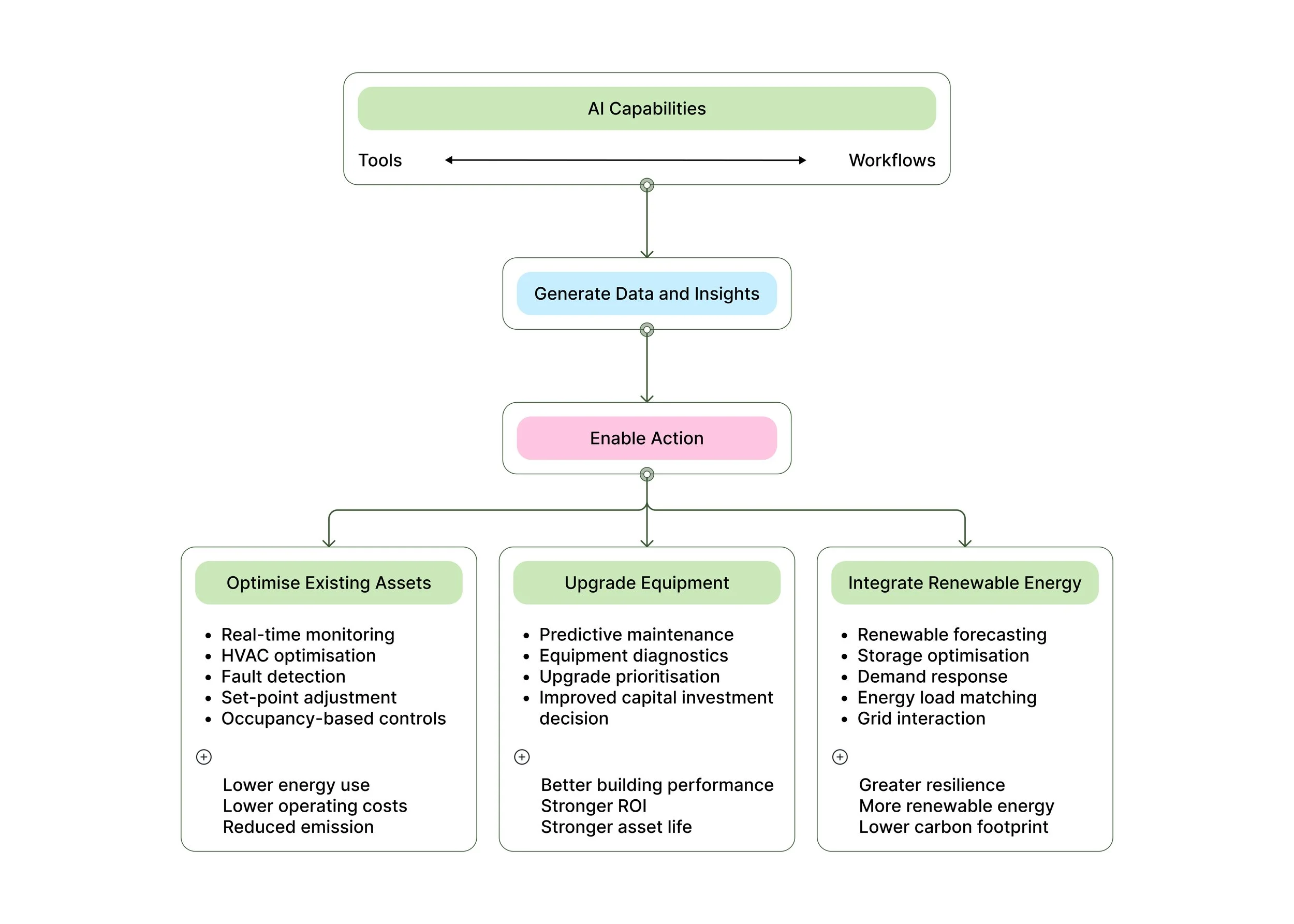
Source: Author’s own elaboration, based on European Commission (2025).
Note. Adapted from How AI improves energy efficiency and management in real estate, by European Commission, 2025, https://build-up.ec.europa.eu/en/resources-and-tools/publications/how-ai-improves-energy-efficiency-and-management-real-estate
The importance of human-centred AI
In a sector facing skills shortages and high operational complexity, AI is highly valuable to automate (repetitive) tasks and workflows, identify emerging issues, and improve the quality and speed of decision-making. However, human oversight remains essential (McKinsey & Company, 2026). AI-generated insights and recommendations must be interpreted, validated, and applied within the specific operational, social, and organisational context of each building (McKinsey & Company, 2026).
Furthermore, AI should be human-centred, meaning that it must prioritise occupant comfort, health, and wellbeing alongside energy efficiency and emissions reduction (European Commission, 2025). When AI is designed and deployed around these human needs, and supported by a people-centred strategy and robust governance, it can help create lower-carbon urban environments that deliver environmental and economic benefits while improving outcomes for owners, managers, and occupants alike.
AI as an iterative process
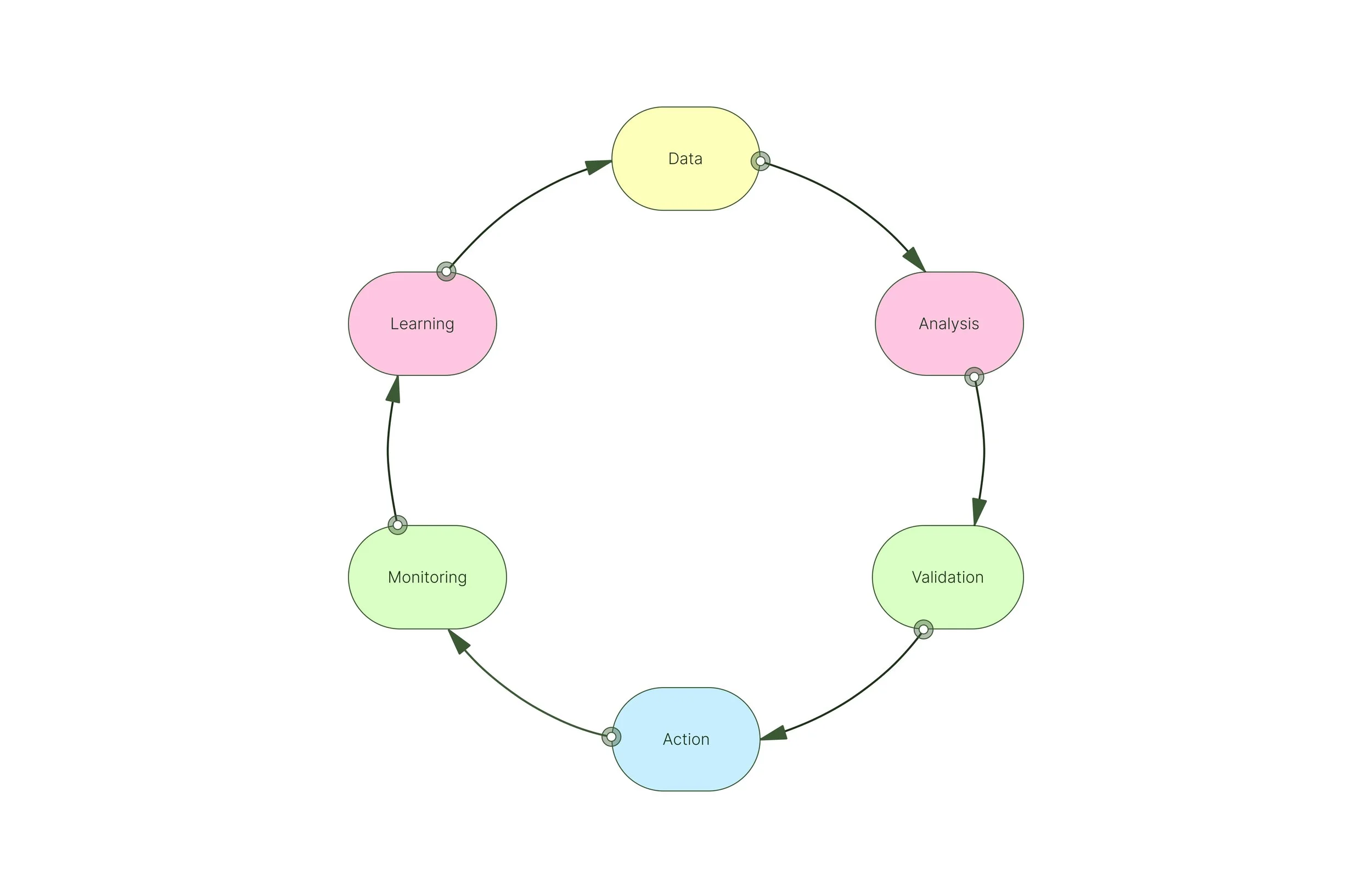
Importantly, AI should not be viewed as a one-off intervention. Its value is created through an iterative feedback loop in which building data is continuously analysed, translated into decisions, and used to inform operational actions. The resulting performance is then monitored and verified, generating new data that enables the system to learn and improve over time.
Figure 2: AI’s iterative process
Source: Author’s own elaboration
The challenge of scaling AI-driven decarbonisation
AI presents a critical paradox for clean technology: while it enables unprecedented opportunities for environmental optimisation in the real estate sector, its deployment also requires significant energy and resource inputs that may offset some of its benefits. In particular, AI’s growing energy demand, much of which is associated with the expansion of data centres, creates a tension with net-zero objectives. As global investment in AI infrastructure approaches $500 billion annually, data centre electricity consumption is projected to increase from 460 TWh in 2022 to between 620 and 1,050 TWh by 2026. At the upper end of this range, the additional demand would be comparable to adding a country the size of Sweden or Germany to global electricity consumption (Wheeler et al., 2026). This expansion raises fundamental questions about AI’s overall environmental impact.
Beyond energy consumption, the main barriers to scaling AI-driven decarbonisation are often organisational. Fragmented data, limited interoperability, insufficient collaboration across the value chain, and a lack of workforce familiarity with AI can all restrict the effective implementation of AI solutions (Nakajima, 2026). In many cases, the limiting factor is not the availability of advanced algorithms, but the ability of organisations to integrate AI into decision-making processes and day-to-day operations.
At the same time, AI can enable 30 to 50% reductions in industrial energy consumption, optimise the integration of renewable energy into power grids, and accelerate clean technology innovation (Wheeler et al., 2026). This dual role thus creates uncertainty for real estate practitioners: deploying AI may unlock significant efficiency gains, but it may also contribute to environmental rebound effects through the energy and resources required to operate the underlying infrastructure. The challenge, therefore, is not whether AI should be deployed, but whether its environmental benefits outweigh its associated footprint in a given application (European Commission, 2025).
Mitigating the AI Energy Paradox
Addressing the AI Energy Paradox requires a dual approach: reducing the environmental footprint of AI infrastructure while ensuring that AI is deployed in applications where its efficiency gains outweigh its resource demands. Although the efficiency of data centres and other AI infrastructure is largely outside the direct control of real estate practitioners, decisions about where and how AI is applied remain within their sphere of influence; therefore, both cases are worth mentioning.
AI is increasingly being used to improve the efficiency of the infrastructure required to operate it. Data centre operators are developing solutions to reduce energy and water consumption, including advanced cooling technologies such as liquid cooling (Pasqualetto et al., 2025). By enabling higher operating temperatures and more efficient heat removal, liquid cooling can improve Power Usage Effectiveness (PUE), with highly optimised systems achieving values of approximately 1.1, compared with around 1.5 for conventional cooling approaches. Beyond improving efficiency within individual facilities, integrating data centres into urban energy systems can further reduce their environmental impact (Lygnerud & Langer, 2022). For example, recovering and reusing waste heat from data centres, particularly through connections to district heating networks and other local energy systems, can improve the overall efficiency of urban energy infrastructure (Lygnerud & Langer, 2022).
Beyond these system-level measures, organisations can also reduce the environmental footprint of AI through decisions made at the application and deployment level. Wheeler et al. (2026) propose three complementary evaluations to assess whether AI deployment is likely to support clean technology objectives:
Asset optimisation potential, which prioritises applications with opportunities for efficiency improvements of more than 20%.
Cost burden assessment, which considers factors such as grid carbon intensity and local water availability, prioritising locations with grid emissions below 200 g CO₂/kWh where water resources are sufficient.
Temporal planning, which incorporates explicit strategies to anticipate and mitigate rebound effects.
According to Wheeler et al. (2026), together, these assessments can help organisations identify the contexts in which AI is likely to generate net environmental benefits and distinguish them from applications where its deployment may create additional environmental pressures. Rebound effects, while challenging, can be addressed through evidence-based strategies. Coupling AI infrastructure with additional renewable energy capacity can help prevent new demand from displacing existing clean electricity. Extending hardware lifecycles from the current two- to three-year cycle to four to six years can reduce embodied emissions and electronic waste. Similarly, alternative cooling technologies, including zero-water and closed-loop systems, can reduce or eliminate freshwater consumption in water-stressed regions. Energy-use targets can also help prevent the rapid expansion of AI infrastructure from overwhelming the efficiency gains it is intended to deliver.
Ultimately, the objective is to ensure that AI is deployed strategically. When supported by appropriate governance, infrastructure improvements, and responsible application choices, AI can become a powerful tool for accelerating the transition towards low-carbon buildings and cities.
References
European Commission. (2025). How AI improves energy efficiency and management in real estate.https://build-up.ec.europa.eu/en/resources-and-tools/publications/how-ai-improves-energy-efficiency-and-management-real-estate
International Energy Agency (IEA). (2025). Energy efficiency 2025: Buildings. https://www.iea.org/reports/energy-efficiency-2025/buildings
Lygnerud, K., & Langer, S. (2022). Urban Sustainability: Recovering and Utilizing Urban Excess Heat. Energies, 15(24), 9466. https://doi.org/10.3390/en15249466
McKinsey & Company. (2026). Where AI is creating value in real estate. https://www.mckinsey.com/featured-insights/mckinsey-explainers/where-ai-is-creating-real-value-in-real-estate
Nakajima, R. (2026). The AI Energy Governance Paradox: Reconciling artificial intelligence’s sustainability promise with its growing power demand. In A. Celentano, A. Kostyuk, S. Dell’Atti, & G. Giovando (Eds.), Corporate governance: Multidisciplinary research (pp. 33–37). Virtus Interpress. https://doi.org/10.22495/cgmrp6
Pasqualetto, A., Serafini, L., & Sprocatti, M. (2025). Artificial intelligence approaches for energy efficiency: A review. arXiv.https://doi.org/10.48550/arXiv.2410.06681
Wheeler, M. R., Everett, B. & Prybutok, V. (2026). Navigating the Environmental Paradox of AI: A Decision Framework for Clean Technology Practitioners. Clean Technologies, 8(2), 51. https://doi.org/10.3390/cleantechnol8020051