The Human Side of Decarbonisation: The Challenges of Retrofitting Occupied Buildings
17 July 2026
The Paris Agreement aims to achieve carbon neutrality in the building sector by 2050 (UNFCCC, n.d.). Yet the building sector still has a long way to go. According to the Global Alliance for Buildings and Construction, the sector faces a gap of around 40 decarbonisation points to reach its climate targets (Global Alliance for Buildings and Construction, 2025).
The scale of the challenge is considerable. Buildings account for around 30% of global energy demand and have contributed roughly one fifth of the increase in energy demand since 2019 (IEA, 2025). In Europe, the challenge is particularly significant because most of today's buildings will still be standing in 2050. Between 75% and 95% of the existing building stock will require energy renovations if the European Union is to meet its climate ambitions (BPIE, 2017).
Retrofitting existing buildings has therefore become one of the defining strategies of urban decarbonisation. Yet buildings differ substantially in their functions, usage intensities, and operational characteristics (Baek et al., 2026). Likewise, the effectiveness of decarbonisation measures varies considerably across building types, making building-type-specific, threshold-based strategies essential for achieving effective urban building decarbonisation (Baek et al., 2026).
Building type and its composition influence operational energy consumption, greenhouse gas emissions, and energy costs (Hachem-Vermette & Singh, 2019; MacNaughton et al., 2015). A distinction between building types is therefore necessary to account for the sector's heterogeneity. Accordingly, this article classifies buildings into two broad categories based on tenant type: residential and commercial buildings.
The residential sector makes up about 70% of total energy demand in buildings, while the remaining 30% is used in commercial and public buildings (IEA, 2025).
Residential buildings account for the largest share of building energy consumption. Globally, in 2020, residential buildings consumed roughly three times more energy than commercial buildings (IEA, 2025). In the European Union, in 2024, the residential sector contributes to 27% of the total final energy, whereas the commercial and public services sector accounted for approximately 13% of total final energy consumption in 2021 (Eurostat, 2026).
At the same time, residential buildings have been shown to present greater decarbonisation challenges than commercial assets. Compared to commercial buildings, residential buildings have been proven to possess lower decarbonisation efficiency and more significant carbon lock-in effects, and to be less cost-effective in decarbonisation (Ma et al., 2022). Decarbonisation strategies therefore need to be tailored to different building types (Baek et al., 2026).
Choosing the right retrofit strategy
The appropriate decarbonisation intervention depends on the building, its condition and its stage in the asset lifecycle. When selecting the most suitable retrofit strategy, tenant type is a key consideration. Commercial decarbonisation is typically a more straightforward, lease-driven process, often welcomed by occupiers who have limited emotional attachment to their workplace. In contrast, residential retrofits require a more people-centred approach, relying on effective tenant engagement through exhibitions, one-to-one consultations, and careful scheduling to minimise disruption, given the personal nature of work carried out in people's homes.
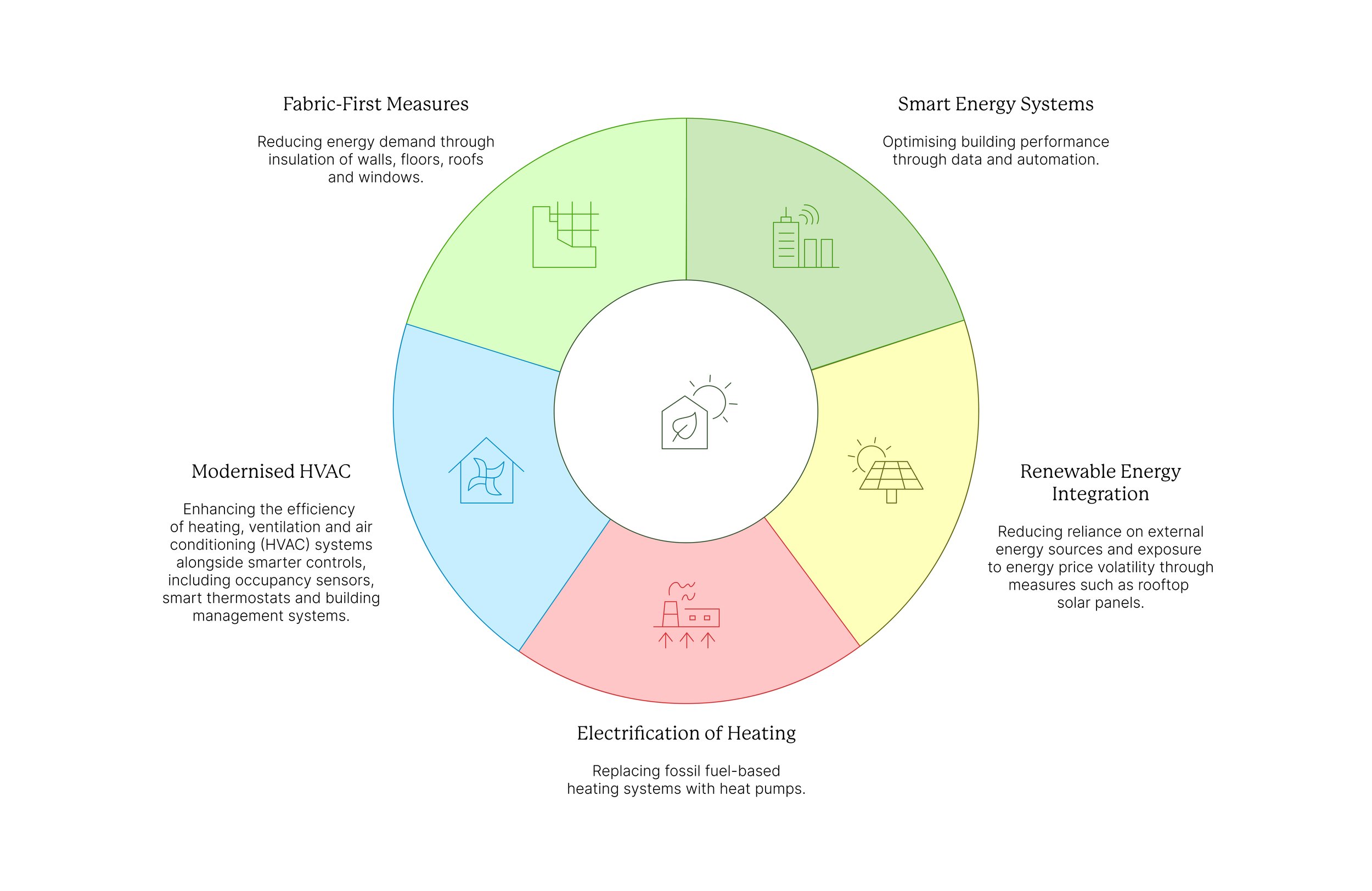
Some of the most common complementary retrofit measures are illustrated in the visual below.
Figure 1: Retrofit measures
Retrofit Measures
Source: Author’s own elaboration
Overall, the appropriate combination of decarbonisation measures depends on both the scale of the renovation and the stage of the asset’s lifecycle. Occupied buildings that are not undergoing major refurbishment may benefit from lower-cost, lower-impact interventions, whereas more extensive retrofit measures are often most effective when incorporated into planned capital expenditure or major asset repositioning.
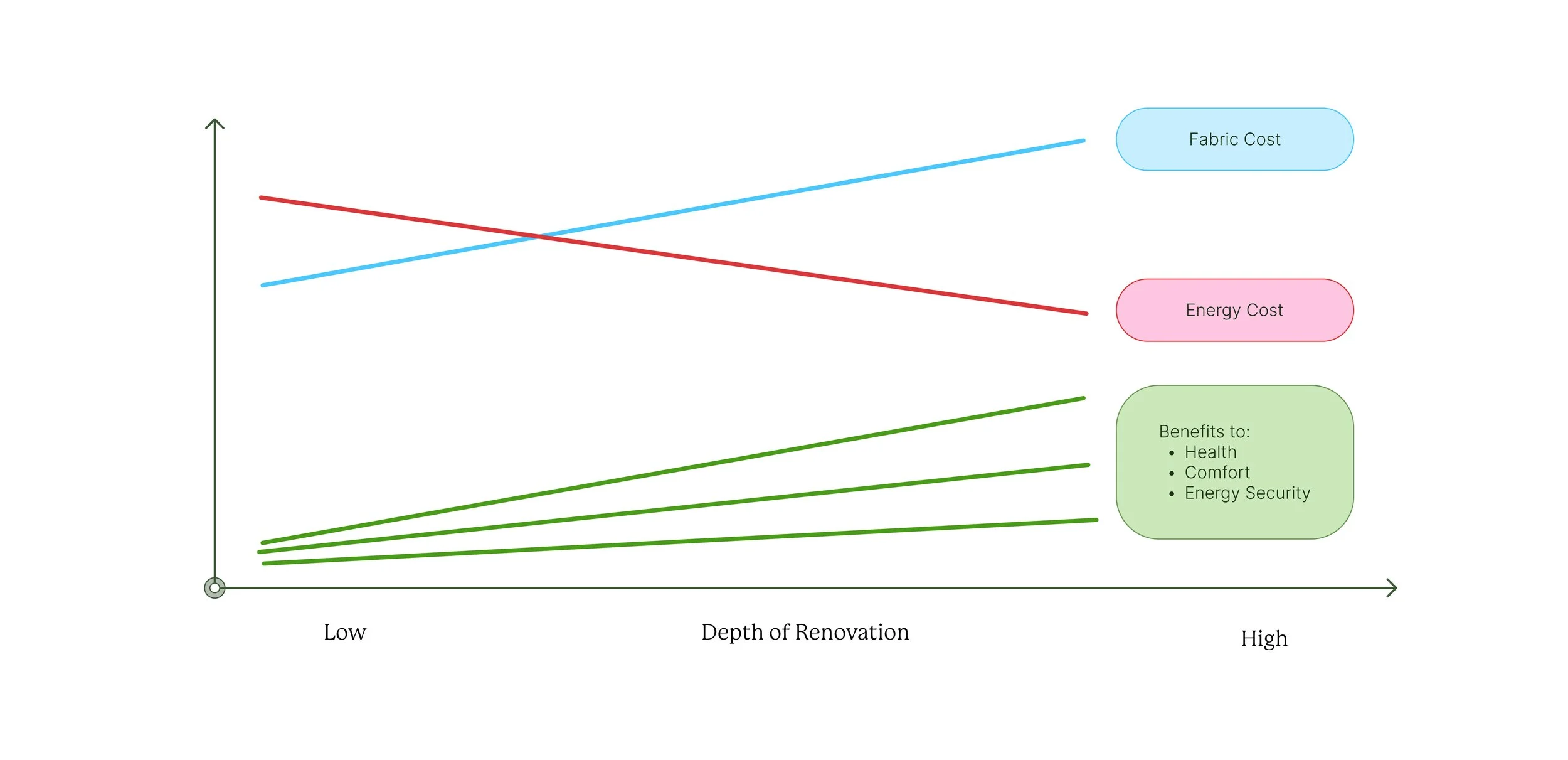
Renovation depth involves a clear trade-off. As the scope of works increases, upfront investment generally rises, while greenhouse gas emissions and operational energy costs decrease. Selecting the appropriate level of intervention therefore requires a case-by-case assessment. In addition to lowering energy costs, deeper renovations can increase asset value, improve occupant comfort and health, and strengthen energy security (Gillett et al., 2025). The figure below illustrates this relationship, showing how deeper renovations generally deliver greater reductions in long-term energy costs. From an investor's perspective, improving a building's energy performance is therefore a long-term investment that strengthens asset value while reducing exposure to future energy price volatility.
Figure 2: Effects of renovation depth on energy costs and building performance benefits
Source: Adapted from Gillett et al., 2025
Best practices for the retrofit challenge
The technologies required to decarbonise buildings are now well established. The greater challenge lies in delivering retrofit projects in ways that work for the people who live and work in them.
Start the conversation early
Successful retrofit begins long before construction starts. Early engagement allows tenants to understand why works are needed, ask questions and gradually build confidence in the project. It also gives project teams the opportunity to identify concerns early and adapt the delivery process where possible.
Communication should also reflect the type of building. Conversations in commercial settings are often relatively transactional, while residential retrofit requires greater sensitivity. Construction takes place inside people's homes, and some residents may perceive interventions as an intrusion into their privacy or everyday routines. Building trust therefore requires time, clear explanations and ongoing dialogue.
Akumen Lab's social impact assessment of the restoration of Dolphin Square, a 1,200-unit estate in London, reached similar conclusions. Residents and other tenants living and working on the estate reported valuing receiving advance notice of upcoming works and having opportunities to discuss concerns directly with project teams. Early communication helped people prepare for disruption and made the renovation process easier to navigate.
The human side of delivery
Retrofitting a home is fundamentally different from retrofitting an office. Commercial projects are often delivered through lease agreements and planned asset management cycles. Residential retrofit affects family life, daily routines and people's sense of home, making relationships just as important as technical delivery.
Small decisions can make a significant difference. Scheduling disruptive works around school terms where possible, organising regular resident meetings and ensuring people can always speak to a member of the project team help reduce uncertainty and build trust throughout construction.
At Dolphin Square, regular meetings gave residents and other involved stakeholders opportunities to raise concerns and provide feedback. In several cases, this directly influenced project delivery. Following discussions with residents, working hours were adjusted to better accommodate daily routines. These small adaptations demonstrated that engagement was more than consultation; it informed decision-making throughout the project.
Align everyone around the same goal
Successful retrofit depends on collaboration between a wide range of organisations. Alongside landlords and tenants, projects typically involve contractors, subcontractors, architects, engineers, sustainability consultants, facility managers, local authorities, utility providers and specialist retrofit contractors. Aligning these actors around shared objectives is essential for delivering projects efficiently and consistently.
Ensure performance after retrofit
Retrofit does not end when construction is complete. Optimising building performance through sensors, building automation, and continuous monitoring is essential to verify that buildings operate as intended and continue to deliver expected energy and carbon savings over time.
However, organisations risk becoming “data rich but information poor” if monitoring data is not actively translated into operational decisions. Smart systems only create value when the information they generate informs action. Whether through automated controls or dedicated staff responsible for interpreting building performance, the objective is to ensure that data supports continuous improvement rather than simply generating reports.
Limitations
This article focuses on retrofit projects in privately owned residential and commercial buildings. Public assets such as schools, hospitals and other institutional buildings present different governance structures, funding mechanisms and operational constraints, and therefore fall outside the scope of this discussion. Other building classifications, including ownership type, may also provide valuable perspectives for future analysis (Cabeza & Bai, 2022).
The discussion should also be understood within its geographical context. Housing markets, lease structures and regulatory frameworks differ significantly across countries. For example, the UK's Full Repairing and Insuring (FRI) lease model creates different incentives for retrofit than the tax structures commonly found in Germany or the comparatively straightforward deployment of rooftop photovoltaic systems on Belgian retail warehouses.
Finally, the article focuses specifically on retrofit projects and does not address new-build construction or full redevelopment.
References
Baek, J., Kim, J., Mossisa, A. T., Park, S., Han, A. T. & Lim, L. (2026). Identifying CO2 emission reduction strategies tailored to different building types by integrating multi-scale factors via deep learning. Sustainable Cities and Society, 148, Article 107585. https://www.sciencedirect.com/science/article/abs/pii/S2210670726004671
Building Performance Institute Europe (BPIE). (2017). 97% of buildings in the EU need to be upgraded. https://www.bpie.eu/publication/97-of-buildings-in-the-eu-need-to-be-upgraded/
Cabeza, L. & Bai, Q. (2022). Buildings. In P. R. Shukla et al. (Eds.), Climate Change 2022: Mitigation of Climate Change. Contribution of Working Group III to the Sixth Assessment Report of the Intergovernmental Panel on Climate Change. Cambridge University Press.https://www.ipcc.ch/report/ar6/wg3/chapter/chapter-9/
Eurostat. (2026). Energy in Europe - 2026 Edition. Interactive Publications. Retrieved July 16, 2026, from https://ec.europa.eu/eurostat/web/interactive-publications/energy-2026
Gillett, W. B., Kalogirou, S. A., Morthorst, P. E., Norton, B., & Ornetzeder, M. (2025). Perspectives on decarbonisation of existing buildings. European Academies' Science Advisory Council. https://easac.eu/fileadmin/user_upload/Gillett-at-al-2025-Perspectives-on-decarbonisation-of-existing-buildings.pdf
Global Alliance for Buildings and Construction. (2025). Global status report for buildings and construction 2024/25. UN Environment Programme. https://globalabc.org/sites/default/files/2025-03/Global-Status-Report-2024_2025.pdf
Hachem-Vermette, C. and K. Singh. (2019). Optimisation of the mixture of building types in a neighborhood and their energy and environmental performance. Energy and Buildings, 204, Article 109466. https://www.sciencedirect.com/science/article/abs/pii/S0378778819319012
International Energy Agency (IEA). (2025). Energy efficiency 2025: Buildings. https://www.iea.org/reports/energy-efficiency-2025/buildings
Ma, M. D., Chen, M. X., Feng, W., & Huo, J. W. (2022). What decarbonized the residential building operation worldwide since the 2000s. Petroleum Science, 19(6), 3194-3208. https://www.sciencedirect.com/science/article/pii/S1995822622002795
MacNaughton, P., Pegues, J., Satish, U., Santanam, S., Spengler, J., & Allen, J. (2015). Economic, Environmental and Health Implications of Enhanced Ventilation in Office Buildings. International Journal of Environmental Research and Public Health, 12(11), 14709-14722. https://www.mdpi.com/1660-4601/12/11/14709
United Nations Framework Convention on Climate Change (UNFCCC). (n.d.). The Paris Agreement. https://unfccc.int/process-and-meetings/the-paris-agreement